By Nathan Donaldson

Two recent papers point at the same idea at the citizen end. The Agentic State (Berlin Global Government Technology Centre, May 2025). And the Tony Blair Institute’s Governing in the Age of AI (May 2024). Both describe a layer where, instead of logging into a portal and filling in a form, an AI agent talks to you and acts on your behalf inside the system.
The Tony Blair Institute calls this a Digital Public Assistant. The Berlin paper calls it the Public Services domain of its tech stack. Different names, same shape.
This is the layer that matters most for the everyday experience of government. If it ships, it’s how most people will meet the state for most things. If it doesn’t ship, Agentic Government mostly stays inside agencies talking to each other.
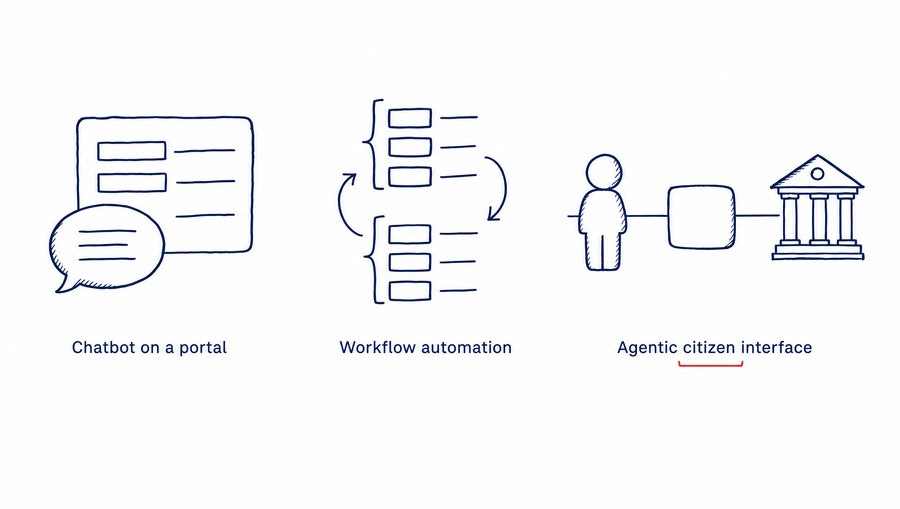
A working definition I’d use: the citizen-interface layer is the part of an agentic government where a goal-pursuing piece of software, not a form and not a chatbot, talks to a citizen and acts inside the government on their behalf.
That’s the claim. Now the harder questions.
A lot of things get called agentic citizen experience that I don’t think qualify.
A chatbot on a portal isn’t this. A chatbot answers questions and points you to a form. It might be polished. It might be helpful. It doesn’t have goals of its own, and it doesn’t act inside the system. It’s a chat layer over an existing portal.
Smart workflow automation isn’t this either. RPA, scripted pipelines, AI tools that route a case from one queue to another. All useful work. Just not the citizen-interface layer. There’s no agent on the citizen side of the conversation.
An AI helper that drafts a letter for a case worker isn’t this. That’s an AI helper for staff, not an agent talking to the citizen.
If you took the agent out of the conversation and replaced it with a scripted call, or a person filling in a form, would the thing still work the same way? If yes, the agent isn’t doing the work. There’s a chat layer over an existing setup.
That’s not a dig at those patterns. Chatbots, workflow automation, and AI helpers all do useful work. They just don’t add up to the same thing.
Last year the OECD looked at what governments are doing with AI. Their Governing with Artificial Intelligence report walked through two hundred real-world cases across eleven government areas. Nearly half, ninety-nine of them, cluster in just three: how public services are designed and delivered, how justice gets administered, and how citizens take part.
Useful work. Most of it is analytics, sorting tools, and AI helpers for staff doing their existing jobs better.
What I don’t see in the two hundred is the citizen-interface layer as The Agentic State and the Tony Blair Institute describe it. Production-grade agentic AI, running all the time, holding goals, acting inside the system, talking to citizens about welfare or immigration or tax. That doesn’t seem to be in the list yet.
That absence is the most honest signal we have. The two named frameworks describe a layer the field hasn’t built. That doesn’t mean it’s wrong. It does mean the talk is currently ahead of the work.
The Agentic State and Tony Blair Institute framings tend to assume that if the tech can do it, citizens will prefer it. Talking to an assistant beats filling in a form, the argument goes. Especially across agencies, because a good assistant won’t make you re-enter the same information four times.
I see the pull of that argument. I also notice it’s an assumption, not yet evidence.
For low-stakes services like booking a rubbish collection or renewing a library card, I’d believe it. The form is a friction tax. Most people would route around it given the option.
For high-stakes services I’m not sure. Think about applying for a benefit at MSD (the Ministry of Social Development), or filing taxes with IRD (the tax office), or putting in a visa application at Immigration New Zealand. Those are conversations where you want to be sure you’ve been heard, sure of what you’ve agreed to, and sure of a paper trail. An AI agent might be faster. It might also feel like talking to something that won’t take responsibility for the answer.
The OECD’s two hundred cases don’t answer this question. Neither does the Berlin paper. The Tony Blair Institute paper sort of waves at it. It’s open.
If I had to put a guess on it, I’d say uptake will split by stakes. People will use an agent to renew a fishing licence on day one. People will hold out longer on benefits, immigration, and tax until the audit story is solid. That’s a guess, not a thesis.
If the citizen-interface layer is going to land, here’s what I’d expect to see in the next two or three years. Not predictions, just markers.
The audit gap is the one I’d bet matters most. I wrote about it last week, walking the world’s evidence on where audit has failed and where it has held up. It’s the layer the field is talking about least and would need most.
Defining the layer this tightly might be wrong. Maybe the citizen-interface layer should include AI helpers that nudge a citizen through a form. Not an agent talking to them. A helper alongside the form. I’ve drawn the line at agent-doing-the-work-on-citizen’s-behalf. I’d hear the case for a softer line if you have one.
“The agent decides” language is contested. Some of the field uses agent to mean any task-running pipeline. The framework writers mean LLM-backed goal-pursuit. I’m using the framework-writer reading. Practitioners often use the looser one. Both are coherent. They lead to different conversations.
Citizen demand might not be the gate. Governments might push agentic citizen interfaces faster than citizens ask for them, on cost or staffing grounds. Citizens end up using them whether they’d have chosen them or not. That’s a different conversation about consent than the one The Agentic State sets up.
If you’ve thought about the citizen end of agentic government, or shipped anything in this space, three questions I’d value an answer on: