By Nathan Donaldson

Picture a caseworker in a New Zealand government agency. Her morning starts with a laptop that logs her in through a national identity service, opens a case in a system older than her career, and checks entitlement details held by another agency. Every one of those things sits at a different place in the architecture. When people write about Agentic Government, they are usually writing about one of those places at a time, and reaching for whichever frame fits the moment.
There are two of those frames, and both are right. One is the stack: what a fully agentic government is built from. The other is the relations: who or what an agent sits between when it acts. They fit together, and laying one across the other gives you a matrix that confirms the central claim of Boost's 5-layer model rather than replacing it. The matrix is Boost's working synthesis of the two frames: proposed as an addition to the model, not yet settled. Claims about agents in government are easier to test when they say exactly which layer and which plane they sit at, and the matrix is what makes that possible.
Boost's 5-layer model is the map of what a fully agentic government is built from. Substrate at layer 1 (identity, authoritative registers, data exchange, compute; the RealMe login, the NHI, the tax ID, the rails between agencies). Internal coordination at layer 2 (agents moving casework between agencies and coordinating a public servant's own work). Citizen interface at layer 3 (agents as the primary front door to a citizen). Work-performance at layer 4 (agents doing the actual work of eligibility, drafting, casework, modelling). Oversight at layer 5 (audit logs, agent registries, rules-as-code, human-in-the-loop, right of appeal, explainability).
The central claim is that layers 2 to 4 are where the agents do the work, and that layers 1 and 5 decide whether that work lands safely. The model is a map, not a maturity ladder. It needs all five layers.
The G2X planes are older. They come from work by the consultancy BearingPoint, which the California Management Review picked up in 2020, and they sit inside the wider Government 4.0 conversation. There are four: Government-to-Citizen (G2C), Government-to-Business (G2B), Government-to-Government (G2G), and Government-to-Employee (G2E), which covers the public servant's own agent.
The planes answer a different question. The model answers what an agentic government is built from; the planes answer who or what an agent sits between in any given transaction. Neither frame is wrong. The mistake is treating them as rivals. That is how a precise claim about agents at the citizen interface and between agencies quietly turns into a vague claim about "agents across the three planes", and the hard questions at layer 4 (the work) and layer 5 (the oversight) drop out of the picture.
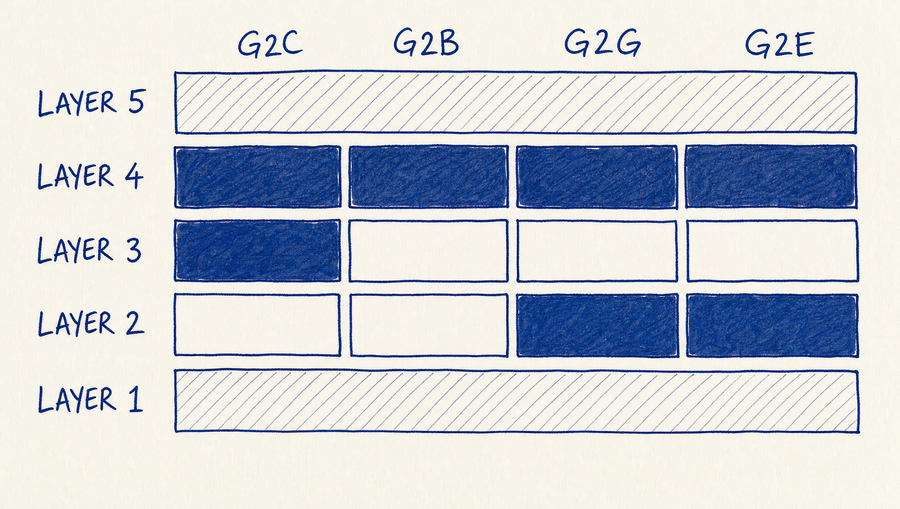
The matrix is the two frames laid across each other: the five layers down one side, the four planes across the top. Any real agent deployment can be placed on it by naming the layer it works at and the plane it works across.
The matrix is not a uniform grid. Three rules decide which cells are real, and all three come straight from the model's own definitions.
Layers 1 and 5 are the same for every plane. There is one set of identity systems and registers, not four. There is one set of audit, appeal and explainability arrangements, not four. The substrate is not "substrate for citizens" and again "substrate for businesses"; it is the substrate, full stop, and every plane stands on it. Oversight works the same way: an agent decision made between two agencies needs the same audit and appeal as one made at a citizen's front door. The planes do not carve these two layers up; they all rely on the same ones. These are the plane-invariant layers.
Layers 2 and 3 already belong to particular planes. The model names the plane inside each definition. Layer 2, internal coordination, is the G2G and G2E story. Layer 3, the citizen interface, is the G2C story. These layers do not stretch across all four planes; each one is a particular plane by definition, and the matrix makes that visible rather than papering over it.
Layer 4 runs across all four planes. Work-performance is the row where the matrix earns its keep. The same capability for checking eligibility can serve a citizen (G2C), a business (G2B), a case moving between agencies (G2G), and a public servant working through their own agent (G2E). One capability, four settings, and four different answers to the question of who is accountable when it gets something wrong.
In the model's own terms: layers 2 to 4 are the plane-active layers; layers 1 and 5 are the plane-invariant ones. Plane-active covers both kinds of middle row: the layers that belong to one plane, and the layer that spans all four. That sentence is the bridge between the two frames. It is the model's existing claim, said in the language of the planes. The matrix does not add a new claim; it shows the structure that was already sitting inside the layer definitions.
The structure, set out as a table. Bold cells carry the model's central claim. Italic cells are the conditions that hold across every plane. Blank cells carry no claim.
The shape is the point. The top and bottom rows run across every column. The two middle interface-and-coordination rows have real cells only in particular columns. The work-performance row has a real cell in every column. The bold cells mark where the agents do the work; the italic rows mark what decides whether that work lands safely. The matrix draws the same picture the model has been describing all along.
G2B is a real plane. It appears in the original BearingPoint work, and the California Management Review treats it as an equal of G2C, G2E and G2G in the wider Government 4.0 transition. But the model does not name a "business interface" layer the way it names the citizen interface (layer 3) or internal coordination (layer 2). That is a deliberate choice, not something the model forgot: the claim Boost defends is specifically about agents making decisions that affect citizens, and agents coordinating between agencies. Agents dealing with businesses exist and matter; they are just not where the model's central claim lives.
In the matrix, G2B shows up cleanly as a column. At layer 1, a business agent runs on the same identity and registers: business identity, incorporation and tax status, the same data-exchange rails. At layer 4, the same eligibility-checking capability, applied to a business case. At layer 5, the same audit and appeal, with rights of review for business processes attached. At layers 2 and 3, nothing defining: a business does not coordinate the way agencies do, and layer 3 is the citizen's front door by definition. G2B is real, has real cells, and folds back into the wider Government 4.0 transition as a column. That is the careful version of an older hunch: that the Agentic Government conversation is mostly about citizens and the work between agencies.
Two pieces of public-sector evidence back this reading up. Layer 1 and layer 5, the two rows the matrix says are the same for every plane, are the two rows where the independent evidence is strongest.
The US Government Accountability Office (GAO-25-107795, 2025) reports that the eleven most critical US federal legacy systems are between twenty-three and sixty years old and cost roughly $754 million a year to run. Of ten critical systems flagged for modernisation in 2019, only three were finished by February 2025. Substrate is, in practice, the longest-lived software in government. Layer 1 does not become disposable because a language model can mock up a copy of it; the identity systems, registers and data-exchange rails are still the slowest-changing layer in the whole architecture, and the layer every agent has to stand on.
Schmitz, Rystrøm and Batzner ("Oversight Structures for Agentic AI in Public-Sector Organizations", arXiv 2506.04836, REALM@ACL2025) argue that public-sector governance today relies on "siloed compliance units and episodic approvals rather than continuous, integrated supervision", and that this cannot keep up with how often agents act. Governance, in their account, has to be "centrally coordinated but diffused" out to the operational departments whose work the agents are helping with. That is the model's layer-5 claim, reached from a different starting point: the oversight that carries audit, appeal and explainability has to hold across every plane and every deployment, and it does not look like what most public-sector governance is today.
Neither reference uses the language of the matrix; the connection to Boost's 5-layer model is Boost's own interpretation. But the evidence points the same way. The two layers the public-sector record shows to be the durable ones are the same two layers the matrix says hold for every plane.
The matrix is Boost's working synthesis: the current way of putting the two frames together, proposed as an addition to the model and still open to change. The model itself, the 5-layer architecture, is settled. The sentence worth carrying away, whether the matrix is adopted or not: layers 2 to 4 are the plane-active layers; layers 1 and 5 are the plane-invariant ones. The model has always said that. The matrix just shows the shape of why.