By Nathan Donaldson
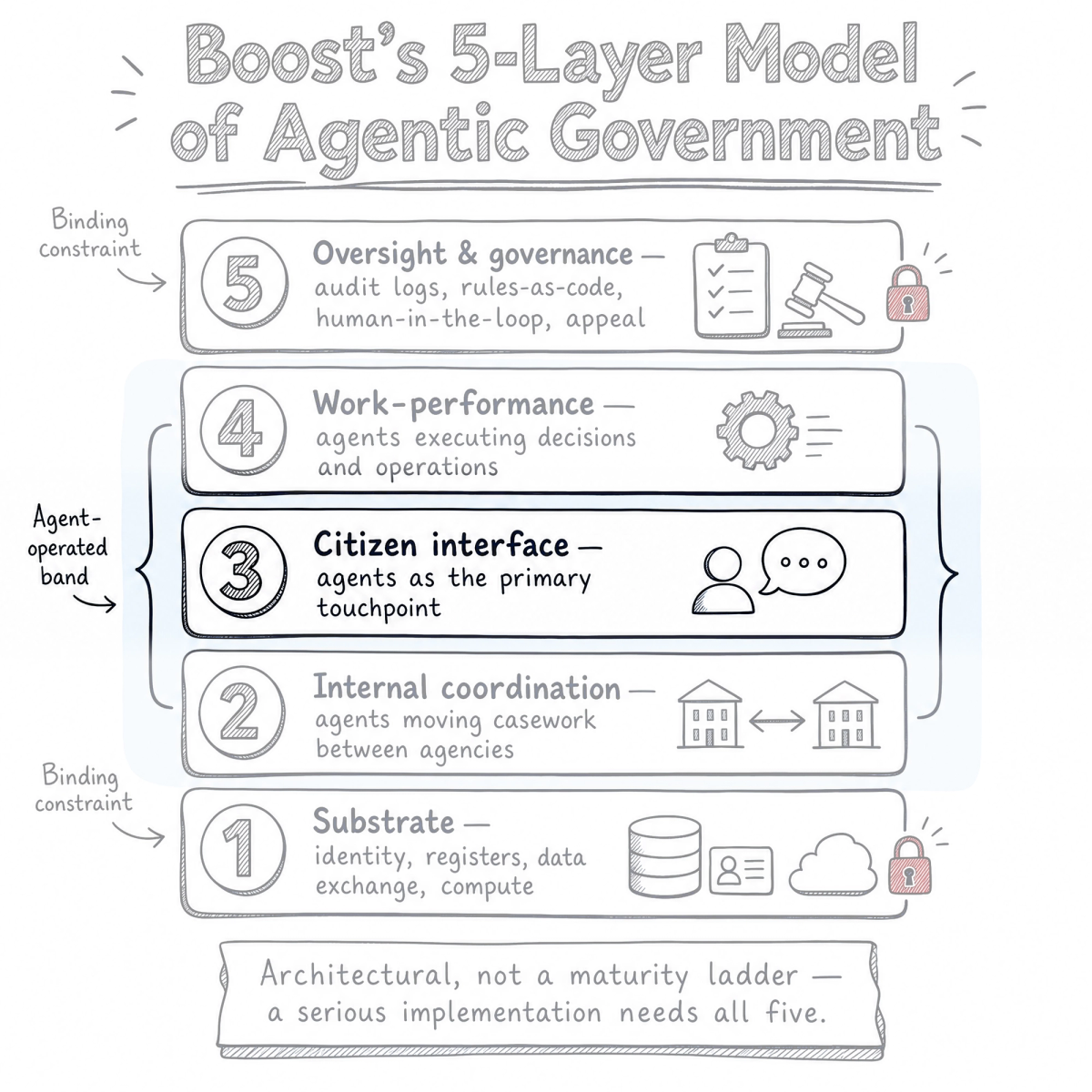
Boost's 5-layer model is a map of Agentic Government. This post is about layer 3, the front door, and the one place where how people feel matters as much as what the machine can do.
Agentic AI is software that can chase goals on its own, not just answer one prompt at a time. The five layers, in brief:
The numbering is about parts, not steps. Today, layer 3.
Layer 3 is the citizen interface. It is an agent as the main way a citizen deals with the state. The front door.
Think of a building's reception desk. It is the part everyone sees, and the part people form an opinion about before they have seen anything else. Reception can be automated. Whether people want to be received that way, when the thing they are there for matters, is a different question.
The point of this layer: capability is not preference. The frameworks assume that once the machine is good enough at the front door, people will choose it. The model treats that as an assumption to test, not a given.
The frameworks are bullish. The Tony Blair Institute proposes a Digital Public Assistant, an agent that talks to citizens. The Agentic State paper has a Public Services domain built on the same idea. Both assume preference will follow capability.
Now the evidence. The OECD ran the most useful study available. Its 2025 report, Governing with AI, looked at what governments are doing with AI in real services, not in pitch decks. It found two hundred real-world cases across eleven areas of government. Nearly half, ninety-nine of the two hundred, cluster in just three areas. How services are designed and delivered. How justice is administered. How citizens take part.
What matters is what is not in the list. Full agents making real decisions at the front door, running all the time, with proper records. Those do not show up. Most of the two hundred are analytics, sorting tools, and helpers for staff. To put it in one line, the OECD case-base does not yet evidence agentic deployment at the citizen-interface tier.
The edge of this shows up in the systems that get called agentic but are not, quite. Singapore's chat assistant, VICA, supports dozens of agencies with more than a hundred chatbots. Useful, busy, real. But a chatbot does not chase a goal on its own or make the substantive call, so it sits just outside the agentic line. Singapore's border clearance is more interesting. In 2025 close to 127 million travellers cleared immigration without producing a passport, and close to 245 million travellers were cleared at land checkpoints. Huge scale. But it runs on biometric and scripted matching, and the real discretionary decisions, like residence and citizenship, stay with humans. Take the autonomy away, put a scripted match in its place, and the same system comes out. By the test the model uses, that is not layer-3 agentic. It is excellent layer-1 work at the front door.
The closest thing to a true layer-3 agent is the United Kingdom's plan for a GOV.UK Agentic AI Companion, meant to help many millions of citizens through life events like job transitions. At the time of writing, it is in procurement, with a pilot planned before any real deployment. A plan, not a running system.
This is the layer where the honest edges are sharpest, because the gap between what the frameworks assume and what the evidence shows is widest.
The capability is arriving on its own, fast, and largely outside government's control. That makes the front door look impressive. It does not settle whether people want it.
And the stakes are not even. The story for renewing a passport or appealing a parking fine is one thing. The story for a declined benefit, a contested visa, or a hearing is another. A framework that assumes one preference holds across both is reaching too far. The evidence for the high-stakes end is simply missing.
There is an equity point here too. When an AI system fails, the citizen feels it at the front door, even when the fault is deeper in the building. Groups who already struggle to be heard tend to feel it first. The interface is where the system becomes real to a person, so it is where failures land hardest.
On this reading, layer 3 will not be decided by capability alone. The machines will be able to greet a citizen well before anyone knows whether the citizen wants to be greeted that way for the things that matter most. That is an open question, and the model treats it as open rather than assuming the answer.
The next post moves to the layer the whole debate fixates on: the work itself.