By Nathan Donaldson
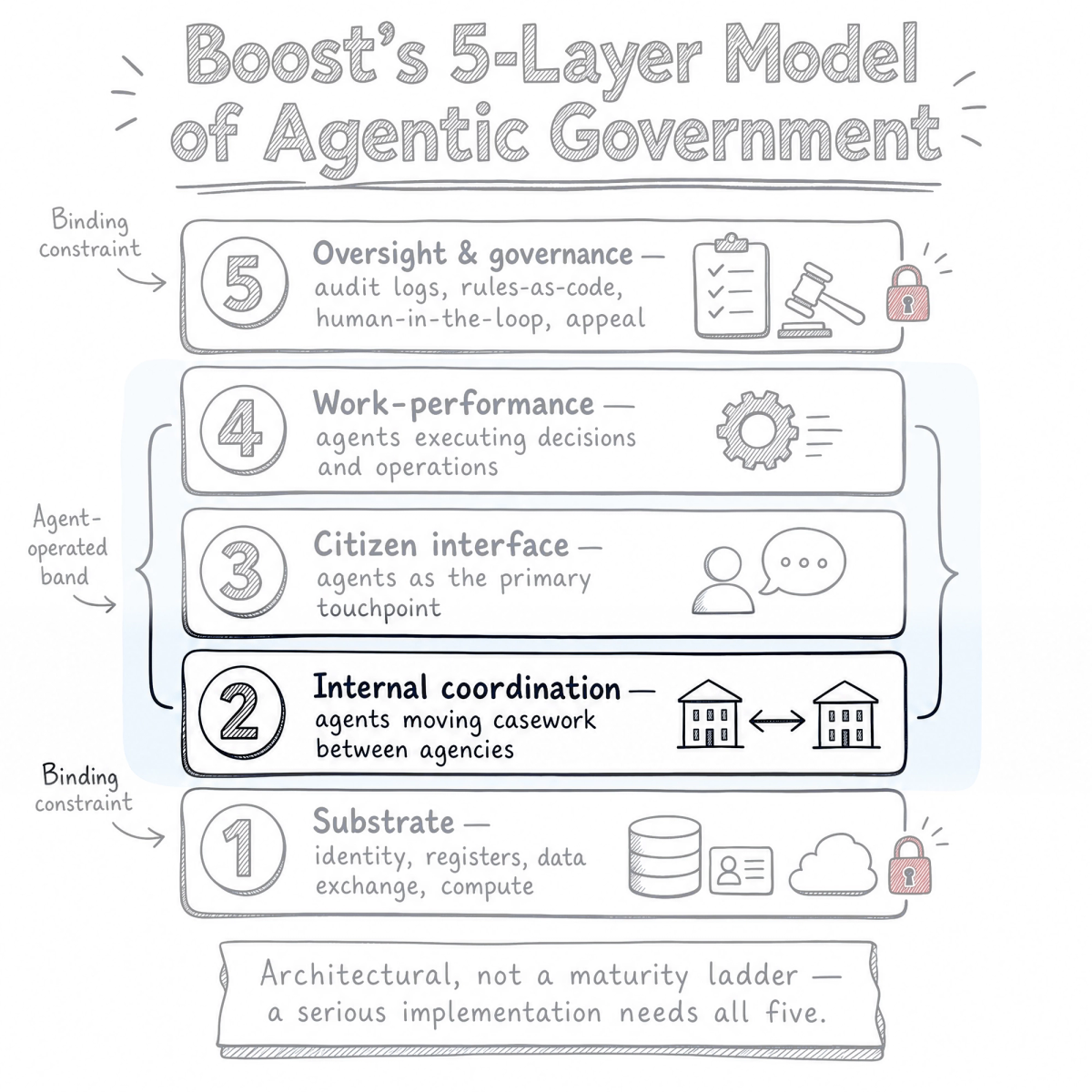
Boost's 5-layer model is a map of Agentic Government. This post is about layer 2, the most interesting layer in the model and the easiest to miss.
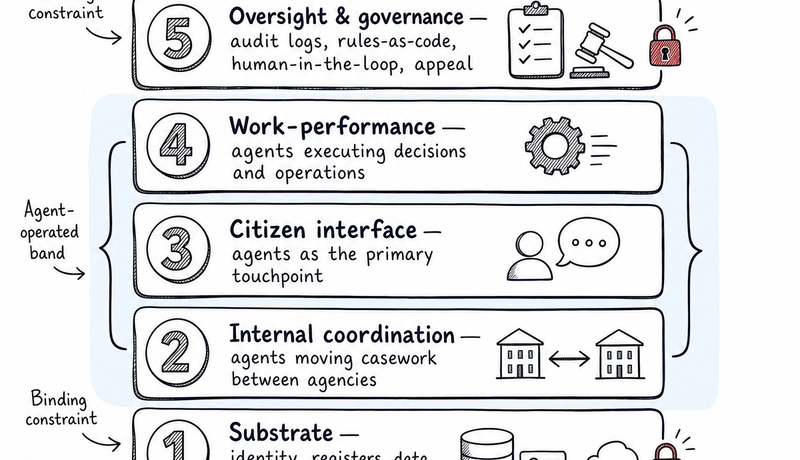
Agentic AI is software that can chase goals on its own, not just answer one prompt at a time. The five layers, in brief:
The numbering is about parts, not steps. Today, layer 2.
Layer 2 is internal coordination. It is agents moving a case between agencies. Working out what happens next when a person's situation touches three places at once.
Think of a building. Layer 3, the front door, is the part everyone sees. Layer 2 is the back-of-house corridors and the plumbing between offices. Re-plumb that, and the whole building runs differently, even though nobody in the lobby can point to what changed.
The point of this layer: the change that is hardest to see is the one that compounds. The leverage in agentic government, the thing that changes the most, sits here. Not at the front door. Most of it will happen out of view.
Picture a benefit claim in Aotearoa New Zealand. A person's situation touches several agencies. Their tax record is at IRD. Other details sit with other agencies. There are signed agreements that let those agencies share data, and the data has moved between them for years.
What does not move cleanly is the case itself. A claim that touches several agencies still routes through people. Forms get re-keyed. Decisions sit in queues. The pipes are digital. The coordination on top of them is not. That gap is layer 2.
The proposals all aim at roughly this spot. The Tony Blair Institute calls it a Multidisciplinary AI Support Team, a layer that helps civil servants reason across the agencies a case touches. The Agentic State paper out of Berlin calls it service orchestration. Underneath, both arguments have the same shape. Agents, not scripted workflow engines, become the layer that moves work between agencies.
Today's cross-agency systems are scripted. They are rule-bound on purpose. Agency A asks agency B. The data comes back. Nothing happens that was not laid down in advance. That predictability is a feature, not a flaw.
An agent-run layer 2 would not be scripted. The agent reads the case. It works out which agencies the work touches. It chases the goal across them. It brings the case to a point where a person, or another agent, takes the next step. The goal can be set at the level the person cares about. Resolve my entitlement, whichever agencies that touches. Not, route this form from A to B. That is the prize. It is also the part that is hardest to keep accountable.
To be plain: as far as Boost has been able to find, no jurisdiction has put a production agent at layer 2 that makes real citizen-affecting decisions, at material scale, sustained over time. There are architectural visions, like the Agentic State's Sovereign Governance Layer. There are internal tools, like coding assistants inside government IT teams. There are chatbots at the front door. None of those is an agent reasoning across agency boundaries on real cases.
New Zealand's law on automated social security decisions is three years old. Subpart 5A of the Social Security Act 2018 came into force on 1 July 2023, and that is where the authority comes from. The Act that passed on 28 May 2026 widens that existing power rather than creating a new one: it extends the scope to an "administrative programme", which means social assistance that does not sit in or under legislation. The Ministry of Social Development has said the automation it uses is rules-based, not generative AI. In its words, not ChatGPT, but simple rules. That is the Ministry's own choice rather than something the statute requires, because nothing in Subpart 5A limits the technology. By the test the model uses, rules-based automation is not yet agentic. Swap the automation for a scripted call or a person following the same rule, and the answer comes out the same. So this is layer-2 groundwork, not a layer-2 agent. And rules-based is the easy case to get oversight right on, because every decision has an explicit rule behind it that can be inspected.
This is where layer 2 gets messy.
An agent that moves a case across three agencies is doing two things at once. It is moving the case, which is layer 2. It is also making the small judgements that shape the outcome along the way, which is layer 4. The model treats those as separate because the trust and audit needs differ. In practice, one deployment can sit across both. That is a real seam in the model, not a tidy line.
It has a practical cost. A scripted system produces a clean trail by design. The rule was followed, here is the log. An agent-run case produces a trail of decisions about how to proceed, and those decisions are reasoned, not rule-bound. Audit at layer 2 means a different thing. Not "was the rule followed" but "was the agent's reasoning, at this step, within the policy." Registries that could carry that kind of audit show up as proposals. They are not running in production anywhere Boost has been able to find.
And because coordination has no front door, it draws no headlines. That is the whole point of this layer. It is also why the evidence on it is thin. There is no neat public tally of inter-agency agent deployments, because the work is invisible by nature.
On this reading, layer 2 is where agents land in government first, and where the architectural confidence is highest while the production evidence is thinnest. The first jurisdiction that crosses the line here, cleanly, will say a lot about how fast the rest of the model arrives.
The next post moves to the layer most commentary fixates on: the citizen interface.
2026-07-30. Corrected: this post dated New Zealand's power to make automated social security decisions to the law that passed on 28 May 2026, when Subpart 5A of the Social Security Act 2018 has carried that power since 1 July 2023; the 2026 Act widens that power rather than creating it.