By Nathan Donaldson
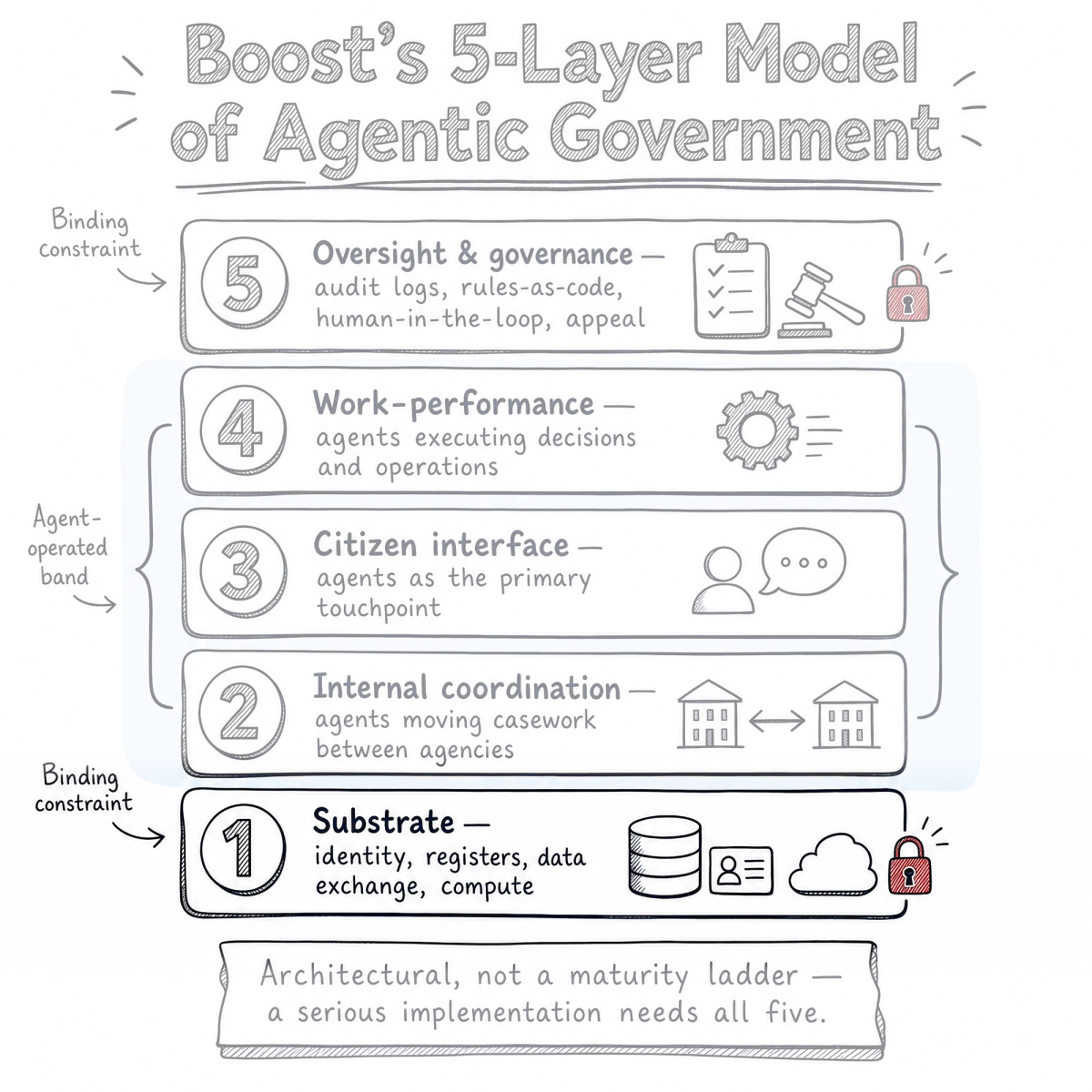
Boost's 5-layer model is a map of Agentic Government. This post is about the first layer, the one that gets the least attention and carries the most weight.
A quick note on words first. Agentic AI is software that can chase goals on its own, not just answer one prompt at a time. Agentic Government is the stage where that kind of software does real government work. The five layers are how the model cuts up that idea:
The numbering is about parts, not steps. A real agentic government needs all five at once. Today, layer 1.
Layer 1 is the foundation. Digital identity. The official registers that hold the true record. The pipes that move data between agencies. The compute underneath all of it. None of this is agentic. No AI chases a goal here. It is the ground the rest of the building stands on.
The point of this layer: to support and enable everything that rests on it. But the load-bearing layer is the boring one. A building's foundations get no admiration. They get noticed when the floor is not level, or when the lights do not come on.
An agent is only as good as the data it can trust. Put a clever agent on top of a poor foundation and it reasons over records it cannot verify. The agent looks smart. The answer is built on sand.
Estonia is the example everyone reaches for, and for good reason. Its data exchange layer, X-Road, has been moving data between agencies for around twenty-five years. Every exchange is authenticated, signed, and logged. The keeper of the system, the Nordic Institute for Interoperability Solutions, describes it plainly: data exchange that is "authenticated, encrypted, logged and governed." Estonia also gives people a data tracker in the national portal, an overview of the operations performed on their records.
That is layer 1 doing its job. Estonia in 2018, digital ID plus X-Road plus electronic registers, was already a real digital state. There was no agent layer at all. It still counted as Government 4.0. It did not count as Agentic Government, because nothing on top chased a goal on its own.
There is a second big example often named in the same breath, India Stack. Different country, same idea: get the foundation right first.
X-Road also carries a useful habit called the once-only principle. Government is given a piece of information once. After that, agencies reuse it from a trusted register rather than asking again. This works because the foundation is solid enough to trust.
A simple test tells layer 1 from the layers above it. Bolt a chat window onto a foundation system and the result is not an agent. It is a foundation with a chat window. That is digital transformation, which is good and useful, but it is not agentic government. The agent has to be doing something the foundation could not do on its own.
Two cautions, because the foundation is easy to oversell.
First, where X-Road is installed is not the same as where it runs a whole country. The system is deployed in many places. The list of pilots is long. A pilot is not a national data plane carrying real load every day. The model treats that difference as real.
Second, and this one sets up the rest of the model. A foundation's audit trail is built for data exchanges between systems. It records that agency A asked agency B, and what came back. That is not the same as auditing a decision an agent made. When an agent starts making calls that affect a person, the question becomes whether the agent's reasoning can be audited to the same standard. That bar has not been met in any production system I’ve reviewed. It is the subject of layer 5, and it is the gap the rest of the model points at.
The big "X percent of GDP saved" numbers that float around about Estonia are best avoided. They are everywhere in trade press and hard to trace to a primary source. The case for the foundation does not need them.
On this model, the foundation is the precondition for everything above it. Skip it, and the agent layer has nothing trustworthy to stand on. Build it well, and the result is not yet agentic government, but agentic government becomes possible.
The rest of the series picks up where the foundation ends.