By Nathan Donaldson
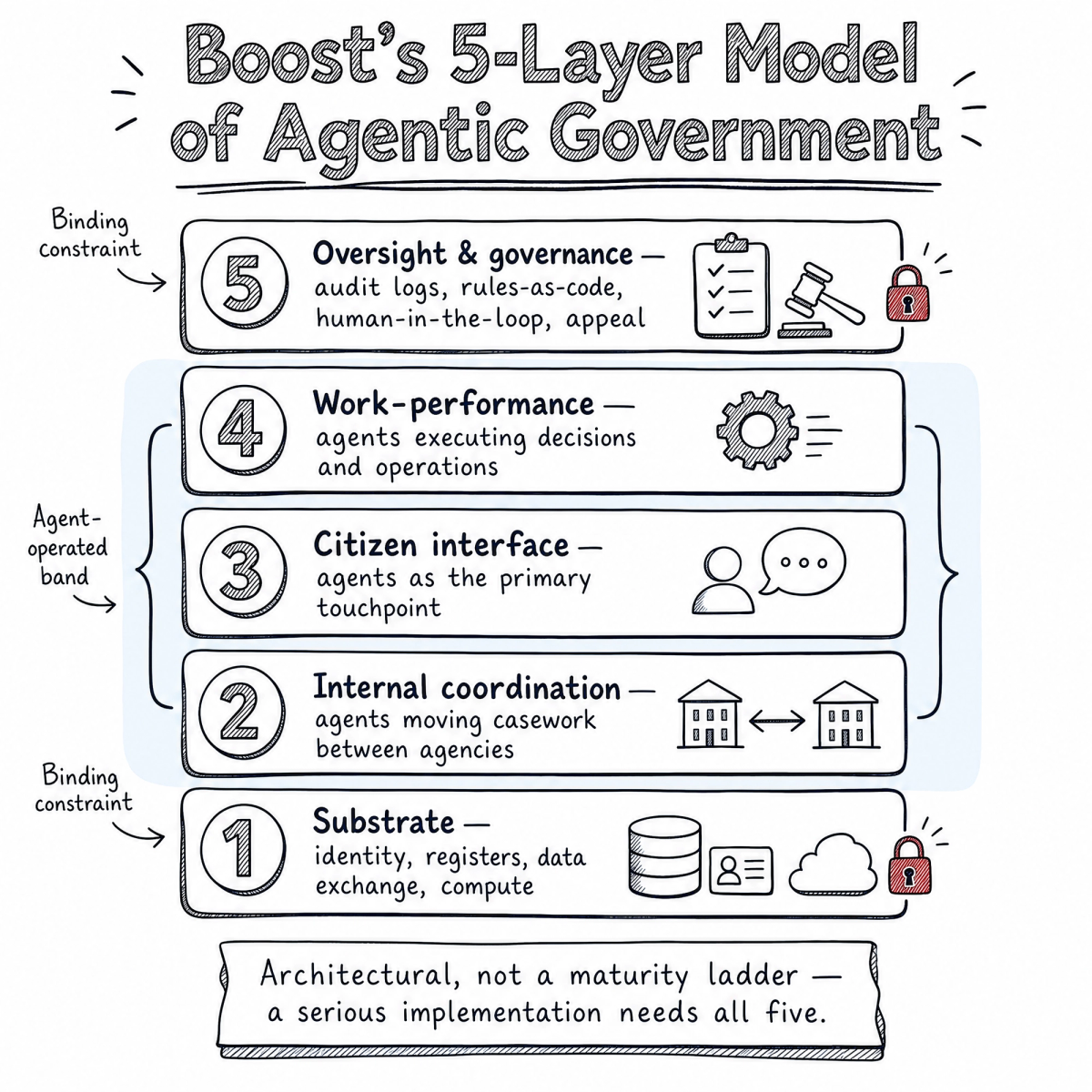
Boost's 5-layer model is a map of Agentic Government. This post is the overview, and the front door to five deeper pieces, one on each layer.
A word on terms first. Agentic AI is software that can chase goals on its own, not just answer one prompt at a time. Government 4.0 is the broad journey: data sharing, digital ID, platforms, automation, and AI. Agentic Government is the narrower stage of that journey where agents do the actual work. Take the agent layer away and a country can still be doing Government 4.0. It cannot be doing Agentic Government.
The model has five layers:
The most important thing to say up front: the numbering is about parts, not steps. There is no climb from layer 1 to layer 5. A real agentic government needs all five at once. Reading the model as a ladder, which is how a lot of the commentary reads it, risks getting the architecture wrong before any agent is built.
A picture helps. Think of a building. The substrate is the foundations and the pipes in the ground. Layers 2 to 4 are the floors where people coordinate, meet the public, and do the work. Layer 5 is the building code, the fire inspection, and the certificate that lets people in.
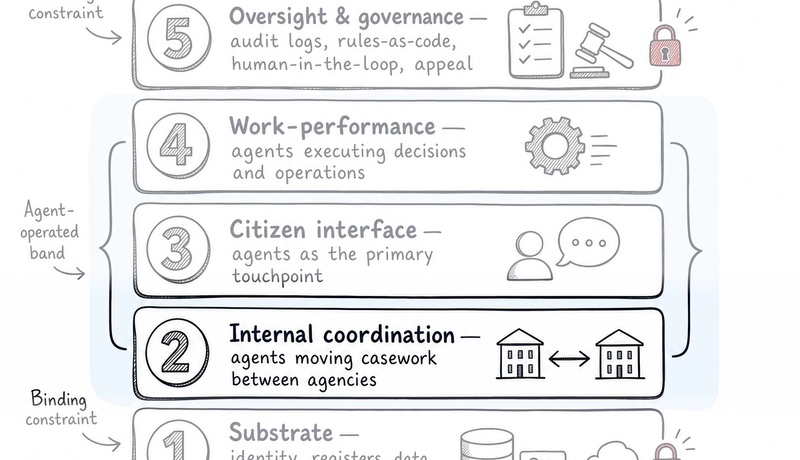
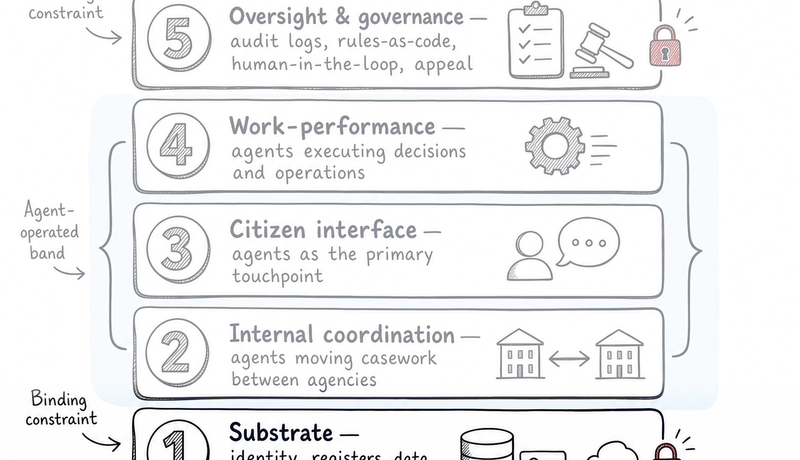
Layer 1, substrate. The foundation. Identity, the official registers, the pipes that move data between agencies. None of it is agentic. It is the ground everything else stands on. Estonia's data exchange, X-Road, has run for around twenty-five years, with every exchange authenticated, signed, and logged. The boring layer is the load-bearing one: an agent on a shaky foundation is reasoning over records it cannot trust.
Layer 2, internal coordination. Agents moving a case between agencies. Today that runs on emails, phone calls, and shared queues. The potential of agentic government sits here, behind the front door, where most of the work has never been visible from outside. The proposals from the Tony Blair Institute and the Berlin Agentic State paper both aim at this layer. The change that is hardest to see is the one that compounds.
Layer 3, citizen interface. An agent as the main way a citizen deals with the state. It is the most visible layer, and the one people have the strongest feelings about. The machines will be able to greet a citizen well before anyone knows whether the citizen wants to be greeted that way, especially for high-stakes things like welfare, immigration, or justice. The frameworks assume preference follows capability, but the evidence doesn’t show it yet.
Layer 4, work-performance. The agent making the actual call: eligibility, drafting, case progression. This is where the whole debate currently lives: are the models good enough? Model skill matters, but it is arriving on its own. Most of what runs in government today is a model helping a person, not a model deciding alone. The layer everyone watches is the wrong place to look.
Layer 5, oversight and governance. In this model, the binding constraint is oversight maturity, not model capability. Audit logs, a register of which agents may do what, rules written as code, a real right of appeal, an explanation a person can read. The ambition for this layer exists on paper. What governments actually have is lighter and mostly voluntary. No production system audits an agent's decision to the bar a citizen-affecting decision deserves.
Boost's thesis is that layers two to four will become agent-operated within three to five years.
Layers one and five decide whether two to four land safely. The foundation has to be trustworthy, and the oversight has to be real. The part most commentary skips, layer five, is the part that determines whether any of it works.
The honest edges of the model, the same ones that run through all five layers: the word "agent" is contested, and a lot of what gets sold as agentic is scripted automation with a chat skin. Layers two and four are not cleanly separable in practice. And whether citizens want an agent at the front door is an open question, not a given.
The rest of this series goes layer by layer. Each post takes one layer, defines it, anchors it to what is actually running in the field, and names where the model bends.