By Nathan Donaldson

Sean came back from a government tech conference last month with two terms on his lips. Agentic Government. Government 4.0. They kept coming up in the talks. A lot of people were using them like they meant the same thing.
When we sat down to debrief, the words stuck with me. I’d been thinking about where government is heading and didn’t quite have the language for it. So I went and read up.
Here’s what I’ve worked out so far. I don’t think the two terms mean the same thing. And I think the difference matters.
This one has German roots. Industrie 4.0 was the name three Germans put on a big idea at a trade fair in 2011. An industrialist, an AI researcher, and a senior public servant. They argued the next big industrial shift would come from joining machines and computers tightly together. They called it “cyber-physical production.” Two years later, a long report turned that idea into the official line. That’s the lineage.
Government 4.0 is what you get when you apply the same idea to the state. The definition I keep seeing in the academic work calls it “the digitization of public service administration to optimize work processes and systems to gain operational efficiencies and boost productivity” (de Marcellis-Warin, Munoz and Warin, 2020). A 2017 BearingPoint framework split it by who’s talking to whom: government to citizen, employee, business, and other governments.
Here’s how I’d hold it. Government 4.0 is the journey. It covers data sharing, digital ID, platforms, automation, and AI. It doesn’t need any AI that runs on its own. Estonia in 2018 fits Government 4.0. Digital ID, X-Road (their cross-agency data backbone), electronic registers, scripted APIs. Estonia in 2026 still fits Government 4.0, with the same setup plus newer AI helpers on top.
One thing about Government 4.0: there’s no single group that owns the term. The OECD doesn’t use it. The Tony Blair Institute doesn’t use it. It mostly lives in academic and consulting writing.
This is the newer term. It started showing up in 2024 and 2025, as AI got good enough that people began taking agentic AI seriously for real government work. By agentic AI I mean software that can chase goals on its own, not just answer one prompt at a time. The clearest framework I’ve found is The Agentic State, launched at the 2025 Tallinn Digital Summit and led by Luukas Ilves, Estonia’s former Government CIO, at the Global Government Technology Centre in Berlin.
That whitepaper defines agentic governments as “governments that operate with greater autonomy, adaptability, and public focus” using agentic AI, which it calls “systems that independently perceive, reason, plan, and act toward goals, far beyond current narrow AI.” That’s a big claim. To their credit, they spend a lot of pages on what would have to be true for the claim to hold up.
The Tony Blair Institute’s parallel paper Governing in the Age of AI (May 2024) describes a “Reimagined State” with three parts. A Digital Public Assistant that talks to citizens. A Multidisciplinary AI Support Team that helps civil servants. A National Policy Twin that models policy choices.
Here’s where I think the line sits. Agentic Government is narrower than Government 4.0. It says you’ve got agents, software that chases goals on its own, doing the actual work. Take that layer away, and you might still have Government 4.0. Agentic Government needs the agent layer to be live.
A quick word note. I keep The Agentic State in capitals as the proper name of that one paper and its framework. The lowercase “agentic state” is the broader idea. The Agentic State is one reading of what that stage could look like. There will be others.
Here’s where I land, and I’m ready to be wrong. Government 4.0 is the journey. Agentic Government is the stage of the journey where agents do the work. The Agentic State is one framework for what that stage could look like.
The field hasn’t settled on any of this. The OECD and the Tony Blair Institute reach for different words. When the two terms get used as if they’re the same, a real difference disappears. It’s not gone forever, but I’d rather keep both terms than mash them into one.
Last year the OECD asked a useful question. What are governments doing with AI right now, in real services, not in pitch decks? Their Governing with AI report came back with two hundred real-world cases across eleven government areas. Nearly half cluster in just three. How public services are designed and delivered. How justice gets administered. How citizens take part.
What gets me is what isn’t in the list. Full-scale agents making real decisions that affect people, running all the time, with proper records of what they did. Those don’t seem to be in the two hundred yet. Most of what is there is analytics, sorting tools, and AI helpers for staff. Useful work. Just a different kind of work.
That’s the gap. Estonia’s X-Road has twenty-five years of records of every cross-agency data swap. Nothing like that exists yet for AI agents.
Some honest edges, the way I see them. These are the bits where smart people in the field disagree, or just haven’t got to the answer yet.
“Agent” itself is up for grabs. The Agentic State and the Tony Blair Institute mean AI that thinks for itself, powered by language models. In the field, “agent” gets used for any task-running workflow, including scripted ones with no AI in them at all. The frameworks pull one way. Everyday use pulls the other. I don’t think this resolves quickly.
We don’t know yet if citizens want an AI front door. Whether people will prefer chatting with an AI over filling in forms, especially for things like welfare, immigration, or justice, is an open question. The OECD’s two hundred cases don’t tell us either way.
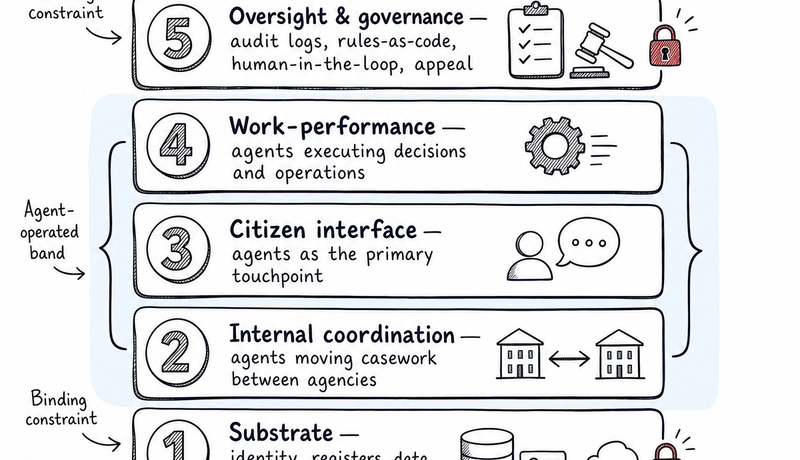
The audit gap is the one that scares me most. Audit logs. Agent registries. Rules written as code. These show up as proposals in The Agentic State and as principles in the Tony Blair Institute’s work on accountability. Real-world versions at X-Road scale don’t exist yet for AI agents. Not anywhere I’ve looked. That’s where I’d put the energy.
The “4.0” framing carries baggage. Industrie 4.0 hasn’t delivered the big revolution it promised. The researcher who helped name it has been honest, ten years on, about how much shipped. Government 4.0 inherits both the pull of the name and the grind of making it real. I’d take the grind more seriously than the pull.
That’s where I’ve got to. I’m sure parts of it are wrong, and I’d like to know which parts. Three questions I’d most like a real answer on:
If you’ve worked on any of this, in New Zealand, Australia, Canada, or anywhere else, send me a note.